
Service revision paperwork
Meter, service conductors, disconnects, and ComEd coordination are different from a panel-only replacement.
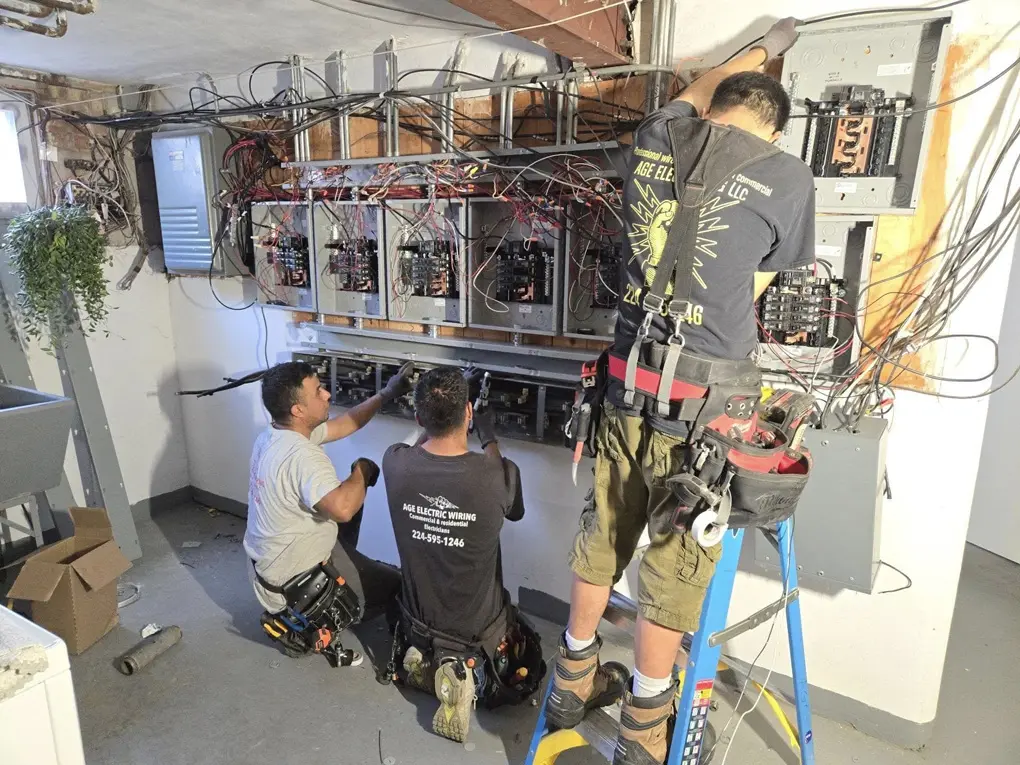
Palatine properties range from established homes and condos to active commercial corridors. A useful panel proposal separates damaged or crowded equipment, added circuit positions, service capacity, and the new loads the property is actually planning.
Send the address or ZIP, equipment goal, panel photos, and route or access details. AGE Electric will confirm what can be priced remotely and what needs an on-site review.
Comparable northwest-suburban planning bands are about $2,000–$6,000 for a subpanel, $3,500–$8,500+ for a panel replacement, and $5,500–$12,000+ for a broader service revision. The quote must say whether it adds circuit space, replaces distribution equipment, or actually changes utility-service capacity.
Straightforward panel replacement field work may fit in one scheduled workday, but the controlled outage is only one part of the timeline. Permit review, equipment availability, utility coordination, service conductors, meter work, relocation, grounding corrections, and inspections can extend the calendar schedule or require additional workdays.
The property, equipment, access, existing conditions, permit, utility, and restoration scope determine AGE Electric’s quote.
These are property and planning conditions—not generic city-name substitutions.
Meter, service conductors, disconnects, and ComEd coordination are different from a panel-only replacement.
The proposal should identify what loses power, the expected controlled outage, and what happens if corrections are found.
EV charging, induction cooking, HVAC, additions, and workshops belong in the load discussion.
Palatine publishes its permit and inspection process online, including separate service-revision guidance. Confirm the current submittal, contractor, ComEd, and inspection steps before fixing an installation or shutdown date.
Village of Palatine Building Permits & InspectionsEach band carries assumptions. A low number and a high number are not comparable if one omits permits, routing, equipment, restoration, or enabling work.
| Comparable scope | Planning range | What it assumes | What can change it |
|---|---|---|---|
| Subpanel installation | $2,000–$6,000 | Additional distribution with adequate upstream service and a defined feeder route | A subpanel creates circuit space; it does not automatically increase service capacity |
| Panel replacement | $3,500–$8,500+ | Comparable equipment replacement, circuit transfer, labeling, grounding review, permit, and testing | Meter, service lateral, relocation, exterior restoration, and utility work may be separate |
| Broader service revision | $5,500–$12,000+ | Service equipment, conductors, meter, exterior routing, or substantial corrections | Utility requirements, underground work, property conditions, and restoration materially change cost |
Use this list to compare the same work from one proposal to another and to expose missing assumptions before the project starts.
These answers keep capacity, access, approvals, cost, and timing visible instead of hiding them behind “it depends.”
No. Replacing distribution equipment does not prove the utility service increased. The estimate should state existing and proposed ratings and name any meter, conductor, disconnect, grounding, and utility work.
A panel generally does not create energy savings by itself. It may address condition, safety, distribution, or capacity, while actual usage and utility rates drive the bill.
It may solve a distribution-space problem, but it cannot create upstream capacity. A load calculation and equipment review determine whether the existing service supports the planned loads.
The controlled outage depends on equipment, circuit condition, utility and inspection sequence, and corrections discovered after opening. The proposal should distinguish outage time from total project lead time.