
Residential or commercial distribution
Voltage, phase, equipment, fault rating, and shutdown planning must match the building.
Schaumburg’s mix of houses, restaurants, offices, retail, and multi-unit properties makes “panel upgrade” too broad by itself. The estimate should name voltage, phase, equipment ratings, affected tenants or rooms, and whether the job changes service capacity.
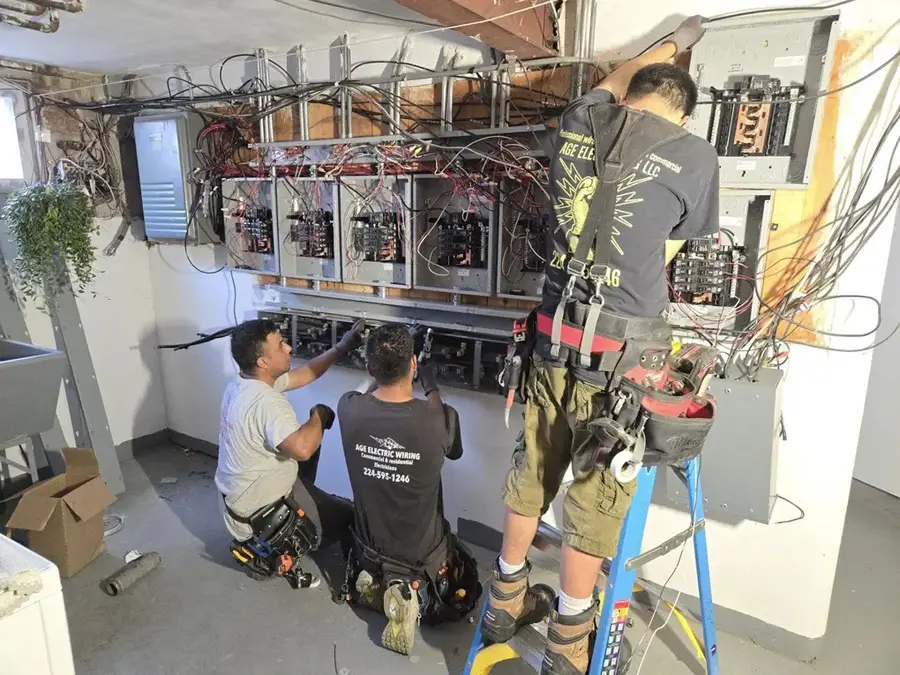
For Electrical Panel Upgrades in Schaumburg, IL, send your address or ZIP, what you want to install or upgrade, panel photos, and details of the wiring route or access. We’ll explain what can be estimated remotely and what needs an on-site review.
For panel upgrade planning in Schaumburg, compare $2,000–$6,000, $3,500–$8,500+, $5,500–$12,000+ against three property-specific conditions: Residential or commercial distribution, Tenant coordination, and Closeout information. These are comparable-work planning bands—not a quote—and the verified property scope decides which band, if any, fits.
A Schaumburg schedule should not be set from field time alone. Resolve Tenant coordination, Closeout information, and the current steps from Village of Schaumburg Permit Services; then AGE can separate installation workdays from permit, inspection, utility, equipment, and restoration lead time.
For the Schaumburg property, equipment, access, existing conditions, permit, utility, and restoration scope determine AGE Electric’s quote.
These three local considerations can affect Electrical Panel Upgrades in Schaumburg, IL. Review them when discussing your property and any approvals the project may need.
Voltage, phase, equipment, fault rating, and shutdown planning must match the building.
Landlord criteria, fire-safety work, equipment schedules, and turnover dates may overlap.
Circuit directories, testing, inspection signoff, and owner documents should be part of the handoff.
Schaumburg maintains dedicated permit services and residential-permit guidance. Identify whether the charger or panel work is residential, multi-family, commercial, or part of a tenant build-out because submittals and coordination can differ. For this panel upgrade scope, the written estimate should separate municipal, utility, and property-owner responsibilities.
Village of Schaumburg Permit ServicesEvery Schaumburg band carries assumptions. Compare routing, equipment, permits, restoration, and enabling work before treating two Electrical Panel Upgrades in Schaumburg, IL totals as equivalent.
| Comparable scope | Planning range | What it assumes | What can change it |
|---|---|---|---|
| Residential or commercial distribution · Schaumburg | $2,000–$6,000 | Voltage, phase, equipment, fault rating, and shutdown planning must match the building. | Also document Tenant coordination and current Village of Schaumburg Permit Services requirements before comparing totals. |
| Tenant coordination · Schaumburg | $3,500–$8,500+ | Landlord criteria, fire-safety work, equipment schedules, and turnover dates may overlap. | Also document Closeout information and current Village of Schaumburg Permit Services requirements before comparing totals. |
| Closeout information · Schaumburg | $5,500–$12,000+ | Circuit directories, testing, inspection signoff, and owner documents should be part of the handoff. | Also document Residential or commercial distribution and current Village of Schaumburg Permit Services requirements before comparing totals. |
Use this Schaumburg checklist to compare the same work across proposals and expose missing assumptions before the Electrical Panel Upgrades in Schaumburg, IL project starts.
These Schaumburg answers keep capacity, access, approvals, cost, and timing visible while planning Electrical Panel Upgrades in Schaumburg, IL.
Provide panel photos and labels, available one-line or floor plans, new-equipment data, landlord requirements, access and shutdown limits, permit status, and the construction schedule.
Voltage, phase, equipment, fault rating, and shutdown planning must match the building. AGE will verify this condition for the actual property before fixing equipment, price, or schedule.
Landlord criteria, fire-safety work, equipment schedules, and turnover dates may overlap. AGE will verify this condition for the actual property before fixing equipment, price, or schedule.
Circuit directories, testing, inspection signoff, and owner documents should be part of the handoff. AGE will verify this condition for the actual property before fixing equipment, price, or schedule.